Share On
South Essex Colleges Group Welcomes Ardmore Group for Mental Health in Construction talks
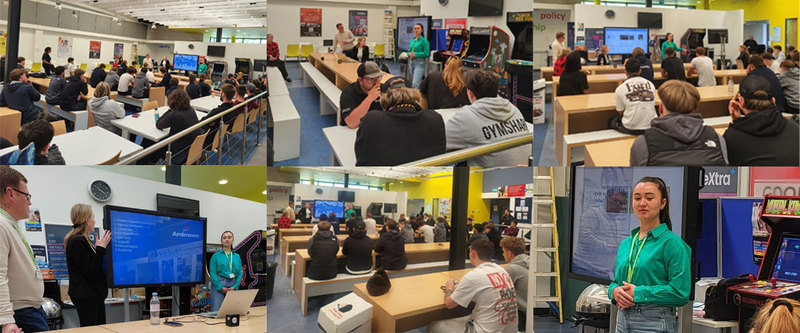
South Essex Colleges Group recently welcomed industry professionals from Ardmore Group to its Luckyn Lane, Thurrock and Stephenson Road campuses for a series of engaging talks focused on mental health and wellbeing within the construction industry.
Leading the sessions was Elizabeth Fitzpatrick, alongside colleagues Dr Luke Hands and members of the wider Ardmore team, who spoke with students and staff about the realities of mental health in construction, the changing culture across the sector and why wellbeing must become part of everyday site life.
The sessions formed part of South Essex Colleges Group’s continued commitment to preparing students for successful careers within construction, engineering and the built environment by connecting them directly with leading industry professionals.
During the visit, Liz took part in a separate Q&A session in which she shared valuable insight into the pressures many construction workers face on a daily basis, including demanding project deadlines, long working hours, job insecurity and the physical challenges associated with working in high-risk environments.
Why does mental health in construction matter more than ever?
Mental health within the construction industry has become one of the sector’s most important conversations - and for good reason.
As organisations increasingly prioritise wellbeing alongside physical safety, businesses such as Ardmore Group are helping to lead the shift towards more open, supportive workplace cultures.
We spoke with Liz Fitzpatrick, HSQE Manager and Group Wellbeing Lead at Ardmore Group, about the realities of mental health in construction, how the industry is evolving and why wellbeing must become part of everyday site culture.
From your perspective, what are the biggest day-to-day pressures affecting workers’ mental health on site?
Significant pressures include tight project deadlines, physical safety concerns, long working hours, maintaining a healthy work-life balance and job insecurity.
The physically demanding nature of construction work, combined with high-risk environments, can contribute to stress, anxiety and depression.
Historically, how was mental health treated within construction organisations?
Traditionally, mental health was often overlooked and heavily stigmatised within the construction industry.
Conversations around mental wellbeing were rare, and there was little formal awareness, support or access to resources for employees and supply chains alike.
Mental health struggles were frequently viewed as a sign of weakness rather than a legitimate health concern.
What are some of the biggest misconceptions about mental health in construction?
One of the most common misconceptions is that mental health problems reflect personal weakness.
There is also a belief among some that mental health issues are not as serious as physical injuries, or that support is unnecessary.
In many cases, people simply lack awareness or understanding of mental health challenges altogether.
What do you think triggered the industry to take mental health more seriously?
For many years, the industry has rightly placed huge emphasis on physical safety to reduce risks on site.
However, growing awareness around mental health statistics has highlighted that wellbeing is equally critical.
Industry leaders are increasingly opening conversations around mental wellbeing through campaigns, summits and awareness initiatives, while recognising the direct impact mental health has on productivity, morale and overall site safety.
What trends are you seeing across the wider construction industry?
There is now a much stronger industry-wide focus on mental health, with more organisations participating in forums, summits and awareness campaigns such as Mental Health Awareness Week.
The sector is also seeing increased use of digital wellbeing tools, stronger collaboration between businesses and greater sharing of best practice through platforms such as LinkedIn.
The idea of creating psychologically safe workplaces is becoming far more central to company culture across construction.
What initiatives has Ardmore introduced to support mental health?
At Ardmore Group, we’ve implemented a number of wellbeing initiatives which include:
- Mental Health First Aiders across sites
- Employee Assistance Programmes (EAPs)
- Mental health awareness workshops and toolbox talks
- Awareness campaigns during Mental Health Awareness Week
- Partnerships with charities including Mind, Construction Sport and the Lighthouse Charity
- ‘I’ve Got Time to Talk’ campaigns encouraging open conversations on site
- A yearly wellbeing calendar focusing on both physical and mental health topics, including cancer awareness, addiction, alcohol, drugs and gambling support
How are you embedding mental health into site culture, not just policies?
Mental health support is most effective when it becomes part of everyday culture rather than a standalone policy.
At Ardmore, leadership plays a key role in driving this change. The company’s Director of Health, Safety, Quality and Environmental, Dr Luke Hands, has dedicated significant research and advocacy towards improving mental health support within construction.
The focus is on creating open communication and safe environments where workers feel comfortable discussing challenges without fear of judgement.
In our experience, through regular engagement, raising awareness and consistent support mechanisms, mental wellbeing can become embedded into daily site life.
What role do leaders and site managers play in changing workplace culture?
Leaders and site managers play a critical role in setting the tone for workplace culture.
Their openness, on-site visibility and commitment to wellbeing initiatives encourage workers to seek support and help reduce stigma around mental health conversations.
When leadership actively prioritises mental wellbeing, it helps normalise these discussions and embeds support into everyday working practices.
What would you say to someone considering a career in construction today?
Construction is an incredibly rewarding industry offering diverse career opportunities, strong earning potential and excellent progression routes.
It gives people the opportunity to work on landmark projects whilst developing specialist skills along the way and being part of building something meaningful.
South Essex Colleges Group continues to work closely with industry partners to ensure students gain valuable insight into the realities of the workplace, helping to prepare the next generation of skilled professionals for successful careers within construction, engineering and the built environment.
Students interested in a future career in construction, engineering or the built environment can explore the wide range of courses available through South Essex Colleges Group and discover where a career in construction could take them.
The college is committed to the wellbeing of our students and staff. We recognise that everyone may need support from time to time with their mental health and wellbeing.
Needing support doesn’t always fit into the 9 to 5 so we have pulled together a range of support services and links to guide you through.
Please contact: Safeguarding@Southessex.ac.uk
Mental Health Support Team
Wellbeing support